
“Learn how fuel level sensors work, compare capacitive, ultrasonic, radar, infrared and laser technologies, understand sensor costs, and discover how digital fuel monitoring can prevent theft and improve fuel accountability.”
Why Accurate Fuel Monitoring Matters More Than Ever
For many businesses, fuel is one of the largest and most difficult operating expenses to control.
Whether the business operates a construction fleet, mining equipment, agricultural machinery, transport fleet, generators, fuel storage tanks or heavy yellow-metal equipment, thousands of litres of diesel can move through an organisation every month.
Yet many businesses still rely on manual dipsticks, handwritten records, fuel slips, spreadsheets or basic tank gauges to determine where their fuel is going.
That creates a fundamental problem:
If you cannot accurately measure your fuel, you cannot accurately manage your fuel expense.
Modern fuel level monitoring systems, automatic tank gauging (ATG), telematics and fuel management systems provide a much more powerful approach.
A properly installed fuel level sensor continuously measures the amount of fuel in a tank. The measurement can then be converted into litres, recorded digitally, time-stamped and associated with a specific:
- Vehicle
- Machine
- Generator
- Fuel tank
- Driver or operator
- Site
- Department
- Project
- Cost centre
- Fuel transaction
This transforms fuel from a difficult-to-control consumable into a measurable business expense.
How Does a Fuel Level Sensor Work?
At its simplest, a fuel level sensor determines the position of the fuel inside a tank.
The sensor produces a measurement that represents the fuel level. Depending on the technology used, this may be:
- Electrical resistance
- Capacitance
- Distance
- Pressure
- Radio-wave reflection
- Ultrasonic echo
- Optical measurement
The electronic system then converts that measurement into a usable value such as:
Fuel level: 68%
or:
Fuel remaining: 1,360 litres
A more sophisticated fuel management system can then record that measurement continuously.
For example:
| Time | Tank Level | Fuel | Machine Status | RPM | Activity |
|---|---|---|---|---|---|
| 07:00 | 1,420 L | 94% | Running | 1,500 | Working |
| 09:00 | 1,285 L | 85% | Running | 1,850 | Working |
| 11:00 | 1,190 L | 79% | Running | 1,600 | Idle |
| 13:00 | 1,050 L | 70% | Running | 1,900 | Working |
| 15:00 | 960 L | 64% | Off | 0 | No activity |
Suddenly, the business has considerably more information than a traditional fuel gauge can provide.
The Real Value Is Not the Sensor — It Is the Data
A fuel sensor on its own is simply a measuring device.
The real value comes from what happens to the measurement afterwards.
A modern fuel monitoring system can collect thousands of individual measurements and turn them into meaningful information.
Instead of asking:
“How much fuel is in the tank?”
management can begin asking:
“How much fuel did this machine consume?”
“How much fuel was consumed while the machine was productive?”
“How much fuel was consumed while idling?”
“How much fuel was used by this cost centre?”
“Why did this vehicle consume 20% more fuel than comparable vehicles?”
“Was fuel removed from the tank when the machine was not operating?”
These are much more valuable questions.
Fuel Should Be Treated as a Cost Centre
One of the most important improvements a business can make is to stop treating fuel simply as a general operating expense.
Fuel should be allocated wherever practical to the correct cost centre, asset, project or operational activity.
For example:
Construction Company
Project A — Road Construction
- Excavator 01
- Wheel Loader 02
- Grader 01
- TLB 03
Mining Operation
Pit 4 — Earthmoving
- Excavator 12
- Dozer 06
- Loader 08
- Haul Truck 17
Agricultural Operation
Farm Operations
- Tractor 01
- Tractor 02
- Combine Harvester
- Irrigation Pump
- Generator
This makes it possible to identify fuel trends at a much more useful level.
Instead of reporting:
“The company spent R850,000 on diesel.”
management can potentially determine:
Project A — R215,000
Project B — R184,000
Earthmoving Fleet — R302,000
Generators — R76,000
Agricultural Operations — R73,000
This creates accountability.
It also makes budgeting, project costing and profitability analysis considerably more accurate.
Preventing Unallocated Fuel Costs
One of the hidden problems with fuel is unallocated consumption.
Fuel may be purchased centrally, but the organisation may not know exactly which asset consumed it.
This creates a gap between:
Fuel purchased
and
Fuel actually consumed by an identifiable asset or operation.
A digital fuel management system can help close that gap.
When fuel levels, refuelling events, machine activity and asset identification are combined, the business can begin reconciling:
Opening fuel + fuel delivered − fuel consumed = closing fuel
This creates an auditable fuel trail.
Any significant unexplained difference becomes something that can be investigated.
Fuel Theft and Unauthorised Fuel Loss
Fuel theft is another major reason to monitor tank levels continuously.
A conventional fuel gauge may show that a tank has lost fuel.
A digital monitoring system can potentially show:
When the fuel level changed.
How much fuel disappeared.
Where the asset was located.
Whether the machine was operating.
Whether a legitimate refuelling event occurred.
For example:
18:42
Machine switched off.
Fuel level:
820 litres
19:03
Fuel level:
610 litres
Fuel difference:
210 litres
No authorised refuelling event recorded.
That creates an immediate exception for investigation.
The system doesn’t have to accuse an employee of theft.
Instead, it provides objective data showing an unexplained fuel event.
This distinction is important.
Good fuel management is about creating an accurate evidence trail.
Different Fuel Level Sensor Technologies
There is no single fuel-level sensor that is perfect for every application.
Tank construction, fuel type, tank geometry, vibration, temperature, installation requirements, required accuracy, budget and hazardous-area requirements can all influence the correct technology.
Some of the technologies commonly encountered in fuel and liquid-level monitoring include:
- Resistive / float-based sensors
- Capacitive sensors
- Ultrasonic sensors
- Radar sensors
- Infrared / optical sensors
- Laser-based measurement
Each technology has its own strengths and limitations.
1. Resistive / Float-Based Fuel Level Sensors
One of the simplest approaches is a float-based sensor.
A float moves according to the fuel level and produces a corresponding electrical signal, commonly a resistance value.
These sensors are widely used because they are relatively simple and cost-effective.
South African suppliers currently list basic fuel-level sensors in the region of approximately R400 to several thousand rand, depending on construction, length, output and specification.
Advantages
- Low cost
- Simple technology
- Widely available
- Easy to interface with many systems
- Suitable for many conventional fuel tanks
Limitations
- Moving components
- Mechanical wear
- Can be affected by tank movement
- Resolution depends on sensor construction
- May require calibration
- Less suitable where extremely precise continuous measurement is required
For many vehicles and equipment applications, however, a correctly selected and calibrated sensor can provide very useful information.
2. Capacitive Fuel Level Sensors
Capacitive sensors measure changes in electrical capacitance caused by the changing level of the liquid.
A probe is installed into the tank, and as the fuel level changes, the electrical characteristics around the probe change.
The electronics translate this change into a level measurement.
Capacitive technology is particularly interesting for fuel tanks and mobile equipment because it can provide continuous measurement without relying on a traditional mechanical float.
Some fuel-specific capacitive sensors are designed for diesel, petrol and other hydrocarbon applications.
For example, one South African fuel sensor specification lists approximately 2% accuracy and 1% resolution, with a price of about R1,510 excluding VAT for that particular model.
Advantages
- No conventional moving float required
- Continuous measurement
- Good resolution is possible
- Suitable for many fuel tanks
- Can be manufactured in different lengths
- Can provide analogue or digital outputs
Considerations
Capacitive sensors require proper calibration.
The characteristics of the fuel, tank geometry, installation position and sensor design all influence the measurement.
They can also be affected by conditions such as contamination or changes in the dielectric characteristics of the medium.
For mobile machinery, calibration and filtering are particularly important because the fuel inside a tank is rarely perfectly still.
3. Ultrasonic Fuel Level Sensors
Ultrasonic sensors use sound rather than physical contact with the fuel.
The sensor emits an ultrasonic pulse towards the surface of the fuel.
The pulse reflects from the fuel surface and returns to the sensor.
The system calculates the distance using the time taken for the signal to return.
Conceptually:
Distance = Speed × Time ÷ 2
The distance to the fuel surface can then be converted into fuel level.
Because ultrasonic sensors can operate without inserting a probe into the fuel, they can be attractive for applications where non-invasive installation is desirable.
One South African ultrasonic tank sensor currently listed at approximately R1,999 advertises non-drilling installation, IP68 protection and a 0.1 mm resolution specification, illustrating how relatively affordable some non-contact solutions can be.
Advantages
- Non-contact measurement
- No moving components
- Can be installed externally in some applications
- Suitable for many liquid applications
- Can provide continuous measurements
Considerations
Ultrasonic measurement can be affected by:
- Temperature
- Vapour
- Foam
- Condensation
- Tank geometry
- Internal obstructions
- Surface turbulence
This means installation and signal processing matter.
For a relatively calm stationary storage tank, ultrasonic measurement can perform very well.
For a heavily vibrating earthmoving machine operating on uneven terrain, the measurement environment becomes more challenging.
4. Radar Fuel Level Sensors
Radar level measurement uses electromagnetic waves rather than sound.
The sensor transmits a radar signal toward the surface of the fuel and analyses the reflected signal.
Radar systems may use different measurement principles, including time-of-flight and FMCW (frequency-modulated continuous wave) technologies.
Radar can be extremely useful where environmental conditions make other technologies less suitable.
Advantages
- Non-contact measurement
- No moving parts
- Good performance over larger distances
- Less dependent on the speed of sound than ultrasonic measurement
- Can be suitable for challenging industrial environments
- High-end systems can provide excellent measurement performance
Considerations
Radar equipment can be considerably more expensive than basic fuel-level sensors.
Current South African industrial listings demonstrate the enormous price difference between basic sensors and industrial-grade radar instruments. Some ATEX-rated radar products listed through RS South Africa are priced at tens of thousands of rand, with certain configurations exceeding R50,000.
Radar therefore becomes particularly attractive when the value of the application justifies the additional investment.
5. Infrared and Optical Level Measurement
Infrared and optical sensors use light to determine the presence or level of a liquid.
These technologies can be useful for specific applications, particularly point-level detection.
For example, an optical system can determine whether a particular level has been reached.
However, there is an important distinction between:
Point-level detection
and
Continuous level measurement.
A sensor that tells you:
“Fuel has reached this point.”
is very different from a sensor capable of continuously reporting:
“There are 1,247 litres remaining.”
For comprehensive fuel management, continuous measurement is generally much more valuable.
6. Laser Level Measurement
Laser-based level measurement uses a laser beam to determine the distance to the liquid surface.
In principle, this provides a highly precise distance measurement.
However, fuel tanks are not always an ideal environment for optical measurement.
Factors such as:
- Vapour
- Condensation
- Surface movement
- Contamination
- Tank geometry
- Reflectivity
can influence performance.
Consequently, laser technology may be highly useful in specialised applications but is not automatically the best choice simply because it can offer high theoretical precision.
Why Sensor Accuracy Isn’t the Whole Story
This is one of the most important considerations when designing a fuel monitoring system.
A sensor advertised as being extremely accurate under laboratory conditions does not necessarily mean that the complete fuel monitoring system will be equally accurate in the field.
Consider a mobile excavator.
The machine is:
- Moving
- Vibrating
- Operating on uneven ground
- Accelerating
- Braking
- Digging
- Tilting
- Moving fuel around inside the tank
The fuel surface can move considerably.
The sensor may therefore detect rapid changes that do not represent actual fuel consumption.
This is known as fuel sloshing.
Filtering and Data Processing Can Improve Real-World Results
A good fuel monitoring system should not simply record every raw sensor reading and assume that every change represents actual fuel movement.
Data processing can be used to identify meaningful changes.
For example:
Raw readings
1,000 L
970 L
1,015 L
982 L
1,004 L
978 L
A basic system might interpret these changes incorrectly.
A properly configured system can apply filtering, averaging and event logic to identify the underlying tank level.
This becomes particularly important on:
Excavators
Wheel loaders
Dump trucks
Graders
Dozers
Agricultural machinery
and other mobile equipment.
Combining Fuel Level With Machine Activity
This is where fuel monitoring becomes significantly more powerful.
Imagine a wheel loader using:
35 litres/hour
while actively loading trucks.
That may be reasonable.
But suppose the same machine consumes:
20 litres/hour
while sitting stationary with the engine running.
That immediately raises a different question.
The fuel data should therefore ideally be analysed alongside other machine parameters.
For example:
Fuel Consumption
18 L/hour
Engine RPM
1,850 RPM
Machine Movement
Stationary
Scoop Activity
No movement
Operating Time
2 hours
This could indicate unnecessary idling.
Compare that with:
Fuel Consumption
18 L/hour
Engine RPM
1,850 RPM
Machine Movement
Active
Scoop Activity
Continuous
The same fuel consumption now has a very different operational context.
This is why the future of fuel management for heavy equipment is not simply about measuring tank levels.
It is about correlating fuel consumption with machine activity.
Fuel Monitoring Can Help Identify Poor Operating Practices
Fuel consumption can be influenced by:
- Excessive idling
- High engine RPM
- Aggressive acceleration
- Incorrect operating practices
- Poor maintenance
- Overloading
- Unnecessary machine operation
- Inefficient routing
- Long warm-up periods
- Unproductive machine hours
When fuel data is combined with telematics and machine operating information, management can identify trends that would otherwise remain hidden.
The objective is not simply to monitor operators.
It is to identify measurable opportunities to improve machine efficiency.
What Does a Good Digital Fuel Record Look Like?
A useful digital fuel record should ideally contain:
Asset identification
Which machine or tank?
Date and time
When did the event occur?
Fuel level
How much fuel was present?
Fuel consumption
How much fuel was used?
Refuelling event
Was fuel added?
Location
Where did the event occur?
Machine status
Was the machine running?
Engine RPM
How hard was the engine working?
Operator / driver
Who was responsible?
Cost centre
Which project or department should carry the expense?
This creates a much more complete digital fuel audit trail.
From Fuel Gauge to Business Intelligence
The ultimate goal is not to create another dashboard.
The goal is to turn fuel data into decisions.
For example:
Fleet A
Average consumption:
22 L/hour
Fleet B
Average consumption:
28 L/hour
That difference deserves investigation.
Or:
Machine 01
Fuel consumption:
18 L/hour
Machine 02
Fuel consumption:
26 L/hour
If both machines perform comparable work, the business now has a measurable reason to investigate:
- Operator behaviour
- Machine condition
- Operating environment
- Maintenance
- Idle time
- Loading conditions
- Fuel measurement
- Productivity
This is where fuel analytics becomes valuable.
How Much Does a Fuel Level Sensor Cost?
There is no single answer.
The cost depends on the technology and the application.
As a broad South African market indication:
| Technology | Typical Position | Relative Cost |
|---|---|---|
| Basic float/resistive | Vehicle/machine tanks | Low |
| Capacitive | Vehicle, machinery, tanks | Low–Medium |
| Ultrasonic | Tanks / non-contact applications | Medium |
| Infrared/optical | Specialised / point measurement | Medium |
| Laser | Specialised precision applications | Medium–High |
| Industrial Radar | Industrial/large tanks | High |
Basic fuel sensors can be available for hundreds to a few thousand rand, while industrial ultrasonic and radar instrumentation can extend into the tens of thousands of rand depending on specification and certification.
For example, current South African listings show basic fuel sensors around R1,000–R3,000, while industrial ATEX-rated ultrasonic instruments can exceed R20,000 and high-end radar instruments can exceed R50,000.
The cheapest sensor is therefore not necessarily the cheapest solution.
The correct question is:
What level of accuracy and reliability is required to protect the value of the fuel being monitored?
The Cost of NOT Measuring Fuel
Consider a business consuming:
100,000 litres of diesel per month.
If only 2% of that fuel cannot be properly accounted for:
2,000 litres/month
At a hypothetical fuel cost of R25/litre:
R50,000 per month
That is:
R600,000 per year
And that is before considering:
- Excessive idling
- Poor operating practices
- Unproductive machine hours
- Maintenance-related inefficiencies
- Incorrect project costing
- Administrative costs
- Lost productivity
A fuel monitoring system should therefore be evaluated against the value of the fuel and the potential losses, rather than simply against the purchase price of the sensor.
Choosing the Right Fuel Monitoring Technology
There is no universal answer.
A good system starts with the application.
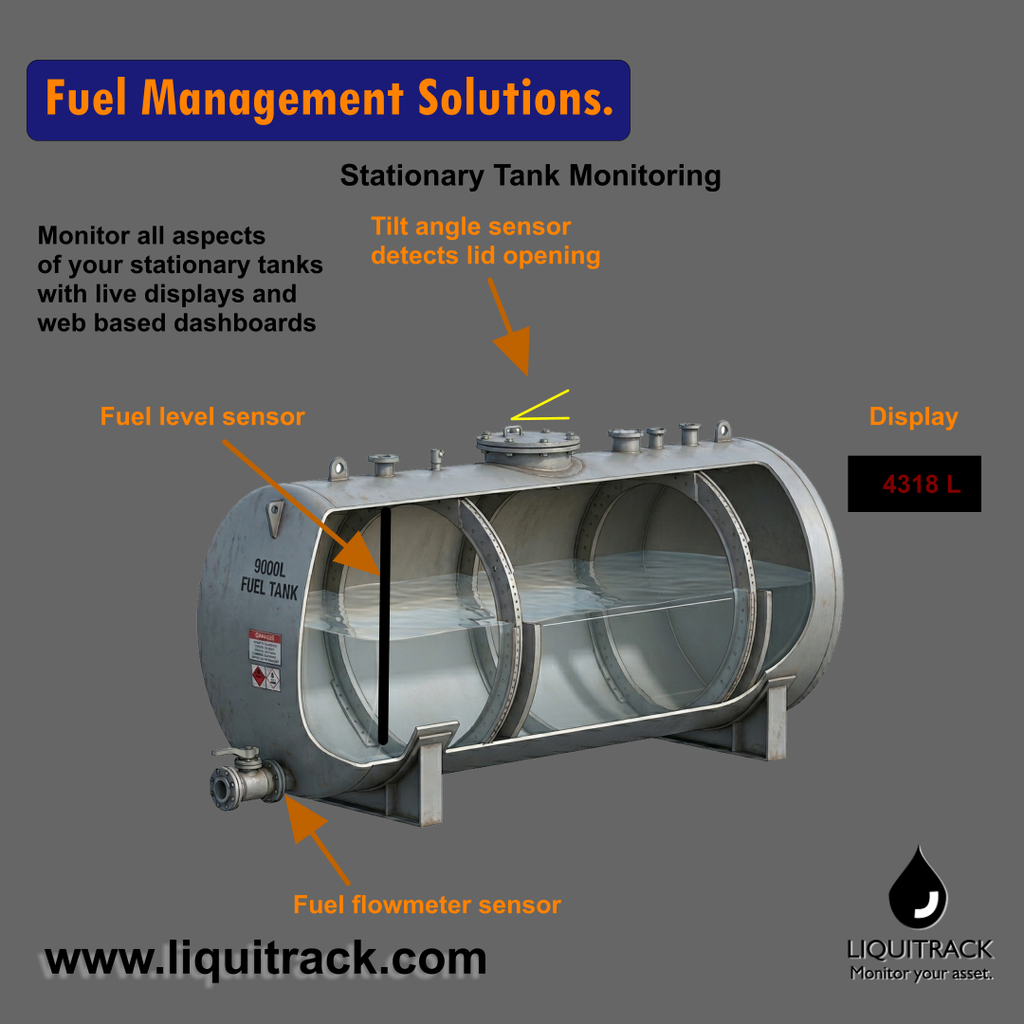
Stationary Bulk Fuel Tank
Radar or ultrasonic may provide excellent non-contact measurement.
Mobile Construction Equipment
A robust capacitive or suitable electronic fuel sensor may be more practical.
High-Vibration Environment
Sensor installation, filtering and calibration become extremely important.
High-Value Fuel Storage
Higher-end radar or industrial instrumentation may justify the investment.
Fleet Vehicles
A proven fuel-level sensor integrated with GPS/telematics may provide the best balance between cost and functionality.
Hazardous Environment
Appropriate hazardous-area certification and installation practices must be considered.
The sensor is only one part of the system.
The Complete Fuel Management Equation
The most effective approach combines several layers:
Fuel Level Sensor
↓
Digital Data Acquisition
↓
Fuel Level & Consumption Calculation
↓
GPS / Asset Identification
↓
Machine Operating Data
↓
Fuel Transactions
↓
Cost Centre Allocation
↓
Analytics
↓
Alerts & Exceptions
↓
Management Action
This creates a closed-loop fuel management system.
The objective is to move from:
“We bought fuel.”
to:
“We know exactly where the fuel went, which asset consumed it, which project incurred the cost, how the machine was operated and where abnormal consumption occurred.”
Why Digital Fuel Records Matter
Fuel is too expensive to manage using incomplete records.
A handwritten fuel book may tell you that:
500 litres were issued.
A digital fuel management system can potentially tell you:
500 litres were issued to Excavator EX-07 at 08:14, the tank increased from 340 to 840 litres, the machine was located at Project B, the operator was logged in, and subsequent consumption was 42 litres over the next six operating hours.
That difference is enormous.
It changes fuel management from an administrative exercise into an operational control system.
Liquitrack: Turning Fuel Measurements Into Actionable Information
Liquitrack focuses on helping businesses monitor, record and understand fuel consumption across vehicles, machinery and fuel storage.
The objective is not simply to provide another fuel gauge.
It is to provide businesses with the information required to:
Monitor fuel levels
Identify abnormal fuel consumption
Improve fuel accountability
Reduce fuel theft and unexplained losses
Monitor machine utilisation
Identify excessive idling
Analyse fuel consumption trends
Improve cost allocation
Create digital fuel records
Make better operational decisions
The right sensor, correctly installed and properly calibrated, provides the foundation.
The real value comes from turning that measurement into reliable, accessible and actionable business information.
Every Litre Should Have a Story
Fuel is an expensive operating expense.
Every litre represents money leaving the business.
The question is whether that litre can be accounted for.
Where did it go?
Which asset used it?
Which project paid for it?
Was the machine working?
Was the fuel consumed productively?
Was the consumption expected?
If not, why?
Modern fuel level monitoring, automatic tank gauging, fuel management software and fleet telematics can help answer those questions.
Because when fuel consumption is accurately measured, digitally recorded and correctly allocated, businesses gain something far more valuable than a tank reading.
They gain control.
Learn more about Liquitrack
Fuel Monitoring | Fuel Management | Fleet Fuel Tracking | Fuel Theft Prevention | Heavy Equipment Monitoring
Visit:
Leave a Reply