
The Diesel Refund Scheme under Schedule No. 6 to the Customs and Excise Act (No. 91 of 1964) remains one of the most significant tax-relief mechanisms for South African primary producers. Designed to relieve primary sectors from the burden of the General Fuel Levy and Road Accident Fund (RAF) levy for off-road operations, the rebate directly impacts working capital and operational costs.
However, the regulatory landscape has recently shifted. While financial relief has expanded, SARS has simultaneously tightened audit protocols. Below is an authoritative breakdown of the legislative changes, how to submit a claim, and the exact steps required to remain fully compliant.
1. Major Changes to SARS Fuel Rebate Legislation
Removal of the 80% Cap (100% Eligible Litres)
Under Rebate Item 670.04, primary sector beneficiaries (farming, forestry, and mining) historically had their diesel rebate capped at 80% of total eligible diesel consumption.
- The Change: SARS formally updated its policy and system calculation methodology to allow qualifying on-land primary production beneficiaries to claim 100% of eligible diesel consumed in qualifying activities.
- The Impact: For high-volume producers, this 20% increase significantly improves cash flow. However, SARS’ updated policy documentation (SE-DSL-02) makes it clear that higher value claims bring increased audit scrutiny.
System Decoupling: Moving Away from VAT Returns
Historically, diesel refund claims were integrated directly into the standard VAT201 return on eFiling.
- The Shift: SARS is transitioning diesel refunds away from the traditional VAT return framework into a standalone digital registration and administration platform.
- While the 100% rate is active, producers must prepare for separated registration protocols on eFiling designed specifically for Excise tracking.
Enhanced Audit Infrastructure & Geotagging
To curb systemic fraud, SARS has introduced tighter digital oversight:
- Geotagged Deliveries: Bulk diesel deliveries must map to specific, verified geographic operational sites rather than generic corporate addresses.
- Verification Audits: SARS now utilizes automated reconciliation algorithms cross-referencing fuel suppliers’ bulk sales against producers’ logbooks before payout approval.
2. Step-by-Step: How Primary Producers Can Make a Claim
Claiming a diesel refund is an administrative process that requires proper sequencing. A breakdown in documentation will cause SARS to stall or reject the claim.
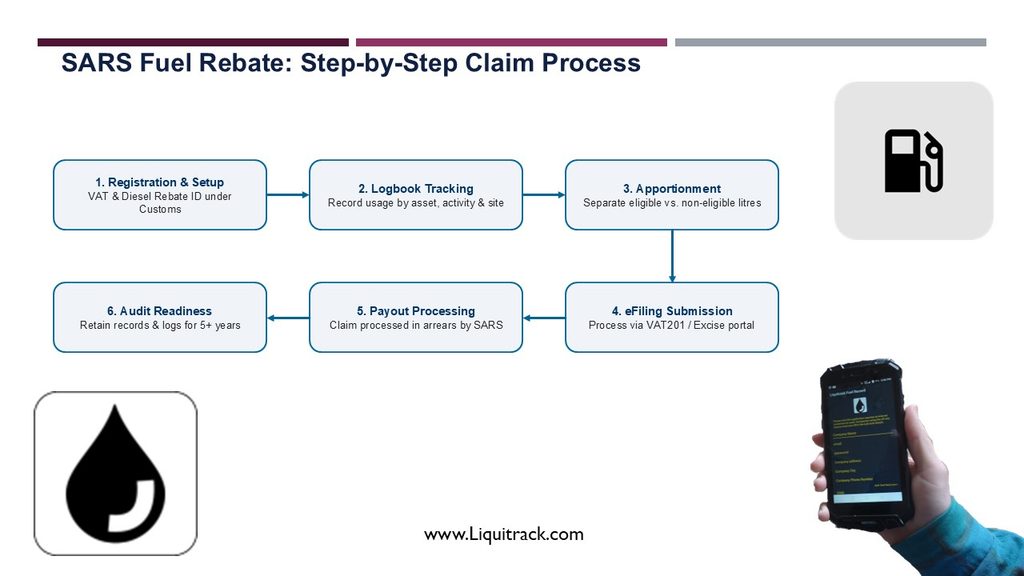
- Meet Prerequisites:
- You must be a registered VAT Vendor.
- You must be explicitly registered for the Diesel Refund Scheme under Customs & Excise.
- You must be the direct purchaser and user of the fuel.
- Maintain Daily Operational Logbooks:
- Fuel cannot simply be bought; it must be tracked directly to qualifying machinery. Logbooks must record: date, vehicle/machine identifier, equipment hour-meter or odometer reading, volume dispensed, and specific primary production activity.
- Calculate and Apportion Usage:
- Filter out non-eligible consumption (e.g., diesel used in management light vehicles, road transport, or secondary processing). Apply the updated formula following policy document SE-DSL-02.
- Submit via eFiling:
- Enter the total eligible litres under the dedicated Diesel Refund section (or through the new Excise portal as SARS rolls out system decoupling).
- Await Processing:
- Because claims are paid in arrears, ensure your accounting team accounts for the timing gap between diesel purchase and payout settlement.
3. Mandatory Compliance Rules for Producers
SARS views the diesel refund as an exception scheme—non-compliance results in automatic clawbacks, interest, and severe penalties.
| Compliance Area | What SARS Demands | Common Pitfall to Avoid |
| Purchasing & Storage | Invoices must be tax-compliant, made out directly to the registered vendor, and show delivery to a designated, verified site. | Invoices made out to personal names, sole proprietors, or third-party contractors. |
| Site Identification | Diesel must be stored and dispensed on approved operational property linked to primary production. | Moving diesel off-site for secondary commercial contract work or logistics. |
| Activity Eligibility | Qualifies: Tilling, harvesting, raw timber extraction, mineral extraction at the face. Excludes: Public road transport, catering, office generators, security vehicles. | Claiming diesel used in transport trucks hauling produce over public roads to market. |
| Apportionment Methodology | A documented, consistent, and audit-proven formula for splitting bulk fuel tank usage between qualifying machines and non-qualifying usage. | Estimating percentages (e.g., claiming a flat “90%” every month without logbook proof). |
| Record Retention | All source documents, tank delivery receipts, pump logs, and telemetry data must be kept for a minimum of 5 years. | Relying on missing paper receipts or uncalibrated dipstick estimates. |
Key Takeaway for Business Owners
The expansion to a 100% eligible claim limit represents a welcome cash-flow boost for South Africa’s primary sectors. However, this additional benefit comes with zero allowance for poor record-keeping. Retrospective reconstructions and estimated logbook entries will not survive a SARS audit.
Primary producers should audit their current telemetry systems, bulk tank dispensation logs, and eFiling registration settings immediately to ensure full compliance.
Leave a Reply